What Is a Boat Fender and How Does It Work?
Release time: 2026-08-07
A pare-battage de bateau is a protective marine device designed to reduce impact between a vessel and a dock, pier, seawall, piling, or another boat. By providing a cushioning barrier between the hull and a hard surface, boat fenders help prevent scratches, dents, and other forms of docking damage.
Boat fenders are widely used on yachts, recreational boats, fishing boats, workboats, and commercial vessels. Selecting the right type, size, and material is essential for effective hull protection.
What Is a Boat Fender?
A pare-battage de bateau acts as a buffer between the vessel and surrounding structures during docking or mooring. When a boat moves toward a dock, its momentum, wind, waves, and water currents can cause the hull to make contact with the structure.
Instead of allowing the hull to hit the hard surface directly, the fender absorbs part of the impact and reduces the force transferred to the boat.
Depending on the application, boat fenders are commonly manufactured from PVC, rubber, or other marine-grade materials. Different designs offer different levels of flexibility, durability, and impact absorption.
How Does a Boat Fender Work?
The working principle of a boat fender is straightforward: it absorbs and distributes impact energy to reduce damage to the hull.
When the boat approaches a dock, the fender makes contact first. The fender then compresses, deforms, or flexes under pressure, absorbing part of the impact.
For example, an inflatable boat fender uses air pressure inside its body to provide cushioning. Foam and rubber fenders rely more on the deformation characteristics of their materials.
After absorbing the impact, the fender helps reduce the force and friction transferred to the hull.
The effectiveness of a boat fender depends on several factors, including its size, material, shape, construction, and operating conditions.
Why Are Boat Fenders Important?
Boat fenders are a basic but important part of docking equipment for several reasons.
Hull Protection
Fenders help prevent direct contact between the hull and docks, pilings, seawalls, or other vessels, reducing the risk of scratches, dents, and surface damage.
Impact Reduction
A suitable fender absorbs part of the impact energy and distributes contact forces over a larger area, helping reduce localized stress on the hull.
Safer Docking
Wind, waves, currents, and passing vessels can make docking unpredictable. Properly positioned fenders provide an additional layer of protection during these conditions.
Reduced Maintenance Costs
By minimizing repeated contact damage, boat fenders can help reduce hull repairs, repainting, and other maintenance requirements.
Common Types of Boat Fenders
Different marine applications require different fender designs.
Inflatable Boat Fenders
Inflatable fenders use air pressure to provide cushioning and are commonly used on yachts, recreational boats, and smaller vessels. They are lightweight, easy to handle, and convenient to store.
Rubber Boat Fenders
Rubber fenders are designed for demanding marine environments and frequent contact. They are commonly used where durability and resistance to repeated impact are required.
Boat fenders can also be produced in different shapes, such as cylindrical, round, and specialty designs, depending on hull configuration and docking requirements.
How to Choose the Right Boat Fender?
Selecting a boat fender should be based on the actual vessel and operating environment rather than size alone.
Boat Size and Weight
Larger and heavier vessels generally require larger or higher-capacity fenders to provide sufficient impact protection.
Hull Design
The shape of the hull determines where contact is most likely to occur. Fender dimensions and shape should provide adequate coverage at these contact points.
Docking Conditions
For boats operating in areas with strong winds, waves, currents, or frequent vessel movement, more robust fender protection may be required.
Material and Construction
Consider the fender’s resistance to impact, abrasion, UV exposure, saltwater, and repeated use. Material selection should match the expected marine environment.
Fender Placement
Even a high-quality fender will not perform effectively if it is positioned incorrectly. Fenders should be placed at the main contact areas between the hull and dock.
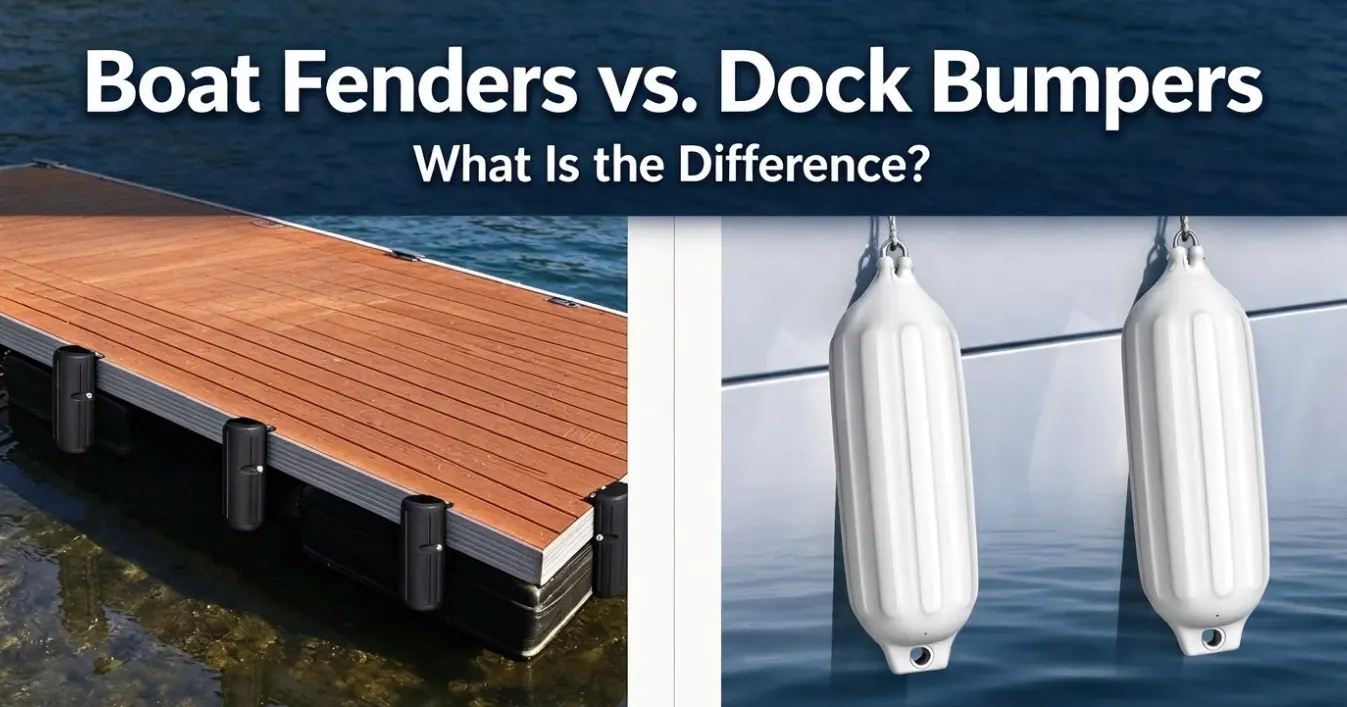
Boat Fender vs. Dock Bumper
Boat fenders and dock bumpers both provide impact protection, but they are used differently.
A pare-battage de bateau is normally attached to the vessel and moves with it, providing protection wherever the boat is docked.
A pare-chocs de quai is generally fixed to a dock, pier, or berth and provides permanent protection for the structure and vessels making contact with it.
In many marine applications, boat fenders and dock bumpers can be used together to provide more comprehensive docking protection.
Common Boat Fender Mistakes
Poor fender selection or installation can reduce protection. Common problems include:
- Using a fender that is too small for the vessel
- Positioning fenders above or below the main contact area
- Using too few fenders for the docking conditions
- Failing to inspect fenders for wear or damage
- Choosing a material that is unsuitable for the marine environment
Regular inspection and correct positioning are essential for maintaining reliable performance.
Conclusion
A boat fender is an essential marine protection device that cushions contact between a vessel and docks, piers, or other boats. Its primary function is to absorb and distribute impact energy, helping protect the hull from damage during docking and mooring.
The right boat fender should be selected according to the vessel’s size, weight, hull design, docking conditions, and required level of protection. Proper placement and regular inspection are equally important for long-term performance.
Whether you need standard boat fenders, customized solutions, or support with product selection, our team can help you find the right solution for your specific requirements.
Contact Xinyue today to learn more about our boat fender solutions and get professional recommendations for your vessel.